
Hot-Dip Galvanizing for Corrosion Protection
Last Updated: September 2026
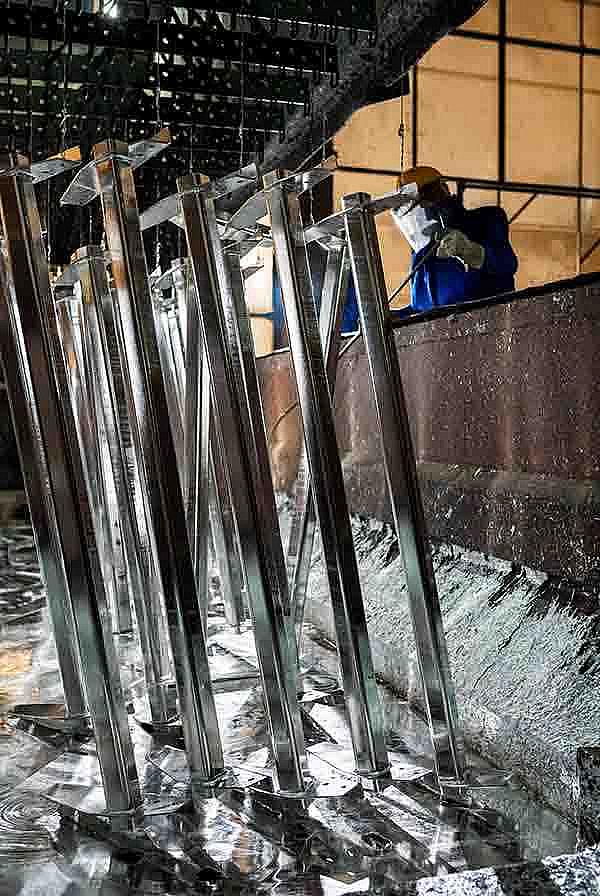
Hot-dip galvanizing protects steel from corrosion by immersing fabricated steel in molten zinc to create a durable zinc–iron alloy coating. This page explains how the process works, how it differs from other zinc coatings, and why it is a preferred corrosion protection method for structural and infrastructure applications.
When fabricated steel is immersed into a galvanizing kettle (bath) of molten zinc the iron in the steel metallurgically reacts with the zinc to form a tightly-bonded alloy coating. The origins of the process date back more than 250 years; however, new technologies and creative chemistry contribute to the continued evolution of this proven process.
Compared to paint-only systems, uncoated weathering steel (UWS), or alternative zinc coatings, batch hot-dip galvanizing typically delivers longer life, more consistent performance, and lower lifecycle maintenance.
For building and infrastructure projects, galvanized steel offers a combination of durability, constructability, and predictable performance that is difficult to match with paint-only systems or uncoated weathering steel. The points below summarize why engineers, architects, and owners frequently select hot-dip galvanizing for structural steel, bridges, utilities, and transportation facilities.
Key Advantages of Hot-Dip Galvanized Steel in Construction
- Long, predictable service life in many atmospheric environments. When specified and applied in accordance with ASTM A123/A123M and related standards, galvanized steel commonly provides over 70 years of corrosion protection with minimal maintenance.
- Factory-applied coating that uniformly protects edges, corners, and interiors of hollow sections
- Excellent damage resistance from the tough zinc–iron alloy layers formed during galvanizing
- Reliable performance across a wide range of structures, from bridges and buildings to utility and transportation infrastructure
- Proven compatibility with duplex systems (galvanizing plus paint or powder) when enhanced aesthetics or extended life is required
Hot-dip galvanizing resists corrosion by providing barrier and cathodic protection, as well as through the development of the zinc patina. These three levels of corrosion protection provide galvanized steel with maintenance-free longevity for decades. Learn more in the hot-dip galvanizing section.
The term "galvanizing" is often incorrectly used to describe various zinc coatings for steel. The AGA, our members, and this website support the process commonly called batch, general, or after-fabrication hot-dip galvanizing in accordance with ASTM A123/A123M, ASTM A153/A153M, ASTM A767/A767M and related specifications, providing reliable, standardized corrosion protection for structural steel. All of the information in the hot-dip galvanizing section pertains to this process and should not be applied to other zinc coatings.
It is important to also understand the hot-dip galvanizing process is NOT the same as in-line or continuous sheet galvanizing.
How Hot-Dip Galvanizing Compares to Other Corrosion Protection Methods
Hot-dip galvanizing is often evaluated against paint-only systems, uncoated weathering steel, and alternative zinc coatings such as metallizing, zinc-rich paint, and continuous sheet galvanizing.
- Paint-only systems: Rely solely on barrier protection. They are susceptible to mechanical damage, edge corrosion, and underfilm rust if not maintained rigorously. HDG combines barrier and cathodic protection and typically delivers two to five times longer maintenance intervals.
- Uncoated weathering steel (UWS): Requires specific environments to form a stable patina. In de-icing salt or marine exposures, corrosion can accelerate and stain adjacent materials. HDG provides predictable performance in these harsh environments and protects adjacent finishes.
- Other zinc coatings: Processes such as electroplating, mechanical plating, and continuous sheet galvanizing create thinner or differently formed zinc layers optimized for fasteners or sheet products. Batch hot-dip galvanizing produces a much thicker, metallurgically bonded zinc–iron alloy coating that is better suited for structural shapes and fabricated assemblies.