
How Steel Moves Through a Hot-Dip Galvanizing Plant: A Step-by-Step Guide

Steel arrives at a hot-dip galvanizing (HDG) plant as a fabricated product. It leaves with a metallurgically bonded zinc coating to provide protection from corrosion for decades. While the concept sounds straightforward, the galvanizing process involves a series of carefully controlled stages to prepare the steel, apply the zinc coating, and verify the finished product meets specification requirements.
Understanding what happens at each stage helps engineers, architects, fabricators, owners, and asset managers make informed decisions about design, fabrication, project schedules, maintenance, and service life.
This article follows steel through a generic galvanizing facility, providing a step-by-step look at what happens from truck arrival to final inspection and shipping. This is not meant to represent any specific plant or process, and all stages vary between galvanizing facilities depending on equipment configuration and process methods.
The Hot-Dip Galvanizing Process
Hot-dip galvanizing differs from painting because the coating does not simply adhere to a profiled surface. During galvanizing, zinc reacts metallurgically with steel to form a series of zinc-iron alloy layers topped by a pure zinc layer. This bond becomes the foundation for the coating's durability, abrasion resistance, and long-term corrosion protection.
The galvanizing process has remained fundamentally unchanged for more than a century because the underlying metallurgy continues to provide reliable, predictable corrosion protection across a wide range of environments.
Design & Fabrication Considerations
The galvanizing process actually begins long before steel reaches the plant. Proper design and fabrication help ensure efficient processing, coating quality, safety, and turnaround time.
Fabricators and designers should consider:
- Venting and drainage locations
- Assembly size relative to kettle dimensions
- Weld quality
- Surface condition
- Material chemistry
- Identification methods
Steel intended for galvanizing should allow cleaning solutions and molten zinc to flow freely throughout the article. Proper venting and drainage also allow galvanized coatings to form uniformly on both internal and external surfaces during immersion in the kettle.
Venting and Drainage: Openings designed into hollow or enclosed fabrications that allow air, cleaning solutions, and molten zinc to move freely through a part during processing.
Step 1: Receiving & Job Verification
As steel enters the hot-dip galvanizing plant, personnel begin by verifying the shipment against project documentation.
At this stage, galvanizers typically:
- Confirm item counts
- Verify material identification
- Inspect for obvious fabrication issues (including checking vent/drain holes)
- Identify any residual coatings which may require additional cleaning
- Weigh steel
- Evaluate lifting and handling requirements
Plant personnel identify any conditions that may affect processing, such as excessive paint, heavy grease contamination, sealed cavities, or insufficient venting. If a serious design flaw is identified, like missing a vent or drain hole on a hollow item, the galvanizer cannot safely proceed until the problem has been addressed. In this example, the hollow part could not begin the process until either the customer or the galvanizer (not all galvanizers offer this service) add any missing vent and drain holes in accordance with ASTM A385/385M, Standard Practice for Providing High-Quality Zinc Coatings (Hot-Dip).
Receiving serves as the first quality checkpoint and helps prevent unexpected delays later in production.
Step 2: Racking & Preparation for Processing
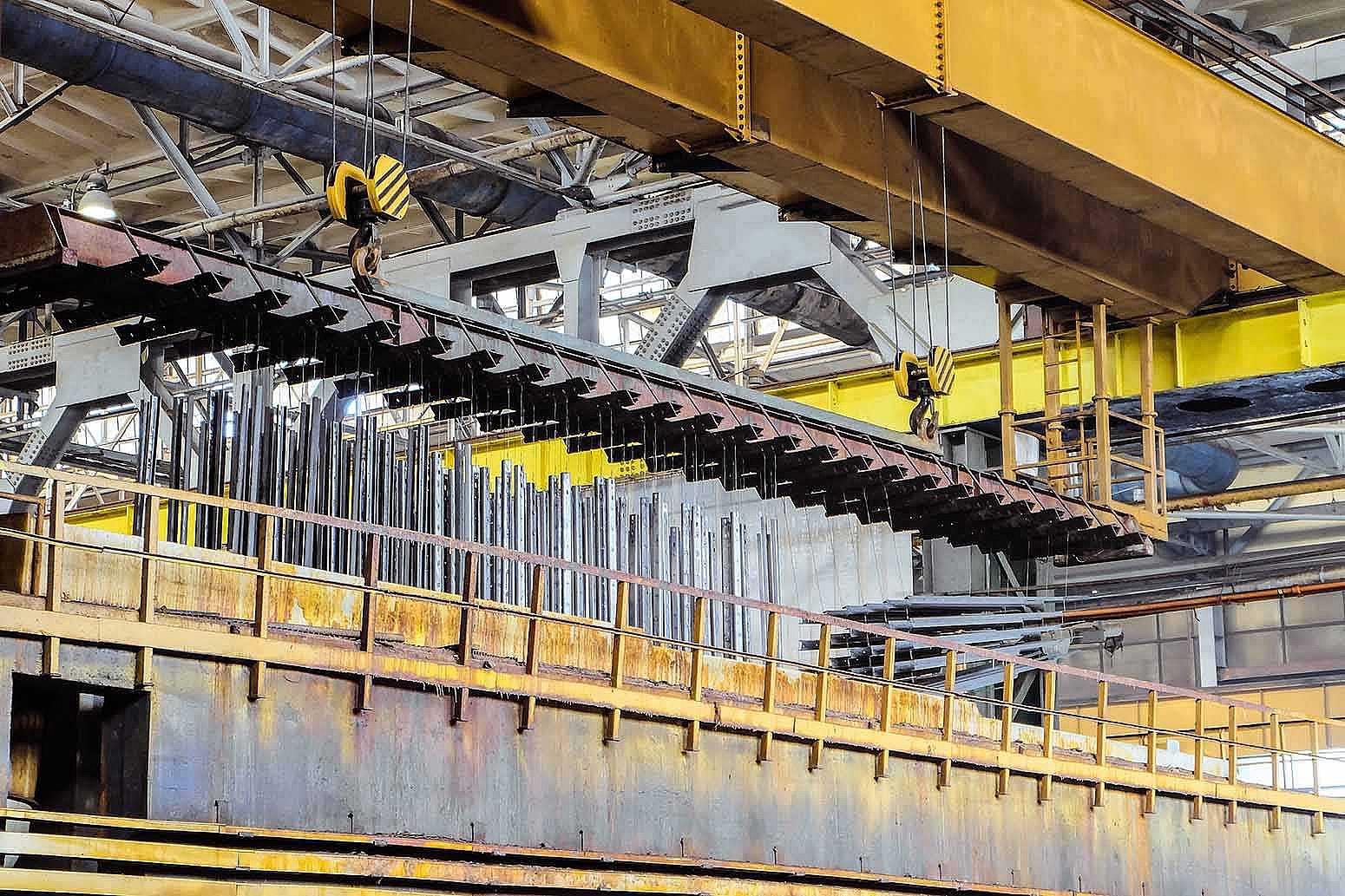
Before cleaning begins, steel is attached to racks, fixtures, or lifting devices.
The orientation of each piece is important because it influences:
- Chemical cleaning efficiency
- Zinc flow characteristics
- Drainage performance
- Coating appearance
Galvanizers select hanging points that allow solutions and molten zinc to move freely across all surfaces. For large structural members, the positioning process may be carefully planned to maximize coating quality and plant efficiency.
Racking: The process of attaching steel to handling fixtures so it can move safely through the galvanizing process.
Step 3: Degreasing and Surface Cleaning
Steel frequently arrives with oils, cutting fluids, shop dirt, marking compounds, or fabrication residues. The first cleaning stage removes these contaminants through a degreasing or caustic cleaning solution. Once all surface contaminants have been removed, the steel is rinsed in fresh water before moving on to the next step.
Step 4: Chemical Cleaning
After degreasing, the steel enters an heated bath, typically containing a dilute hydrochloric or sulfuric acid solution.
This stage removes:
- Rust
- Mill scale
- Iron oxides
- Surface corrosion products
Mill scale can be particularly difficult because it forms during steel production and often bonds tightly to the steel surface. The chemical cleaning process exposes clean, reactive steel that allows the zinc-iron metallurgical reaction to occur during galvanizing. The steel is then rinsed to remove residual acid and dissolved contaminants.
Step 6: Fluxing
After rinsing, the steel enters what is known as the flux solution.
Fluxing performs several important functions:
- Removes light oxides that may have formed after pickling
- Helps prevent additional oxidation prior to galvanizing
Without flux, clean steel could quickly develop oxide films that interfere with coating formation.
Flux: A chemical solution that helps maintain a clean steel surface and promotes the zinc-steel reaction during galvanizing.
Step 7: Drying
Many galvanizing operations incorporate a drying or preheating stage before immersion in molten zinc.
Drying helps:
- Remove residual moisture
- Improve process efficiency
- Reduce the potential for zinc splatter
- Prepare steel for immersion
Step 8: Galvanizing
After the steel has been cleaned and fluxed it then moves to the galvanizing kettle. This large process vessel contains molten zinc maintained at approximately 815-850 F (435-455 C), although operating conditions vary among facilities. This is where the defining reaction of hot-dip galvanizing occurs.
Galvanizing Kettle: A specially designed vessel that contains molten zinc used during the hot-dip galvanizing process.
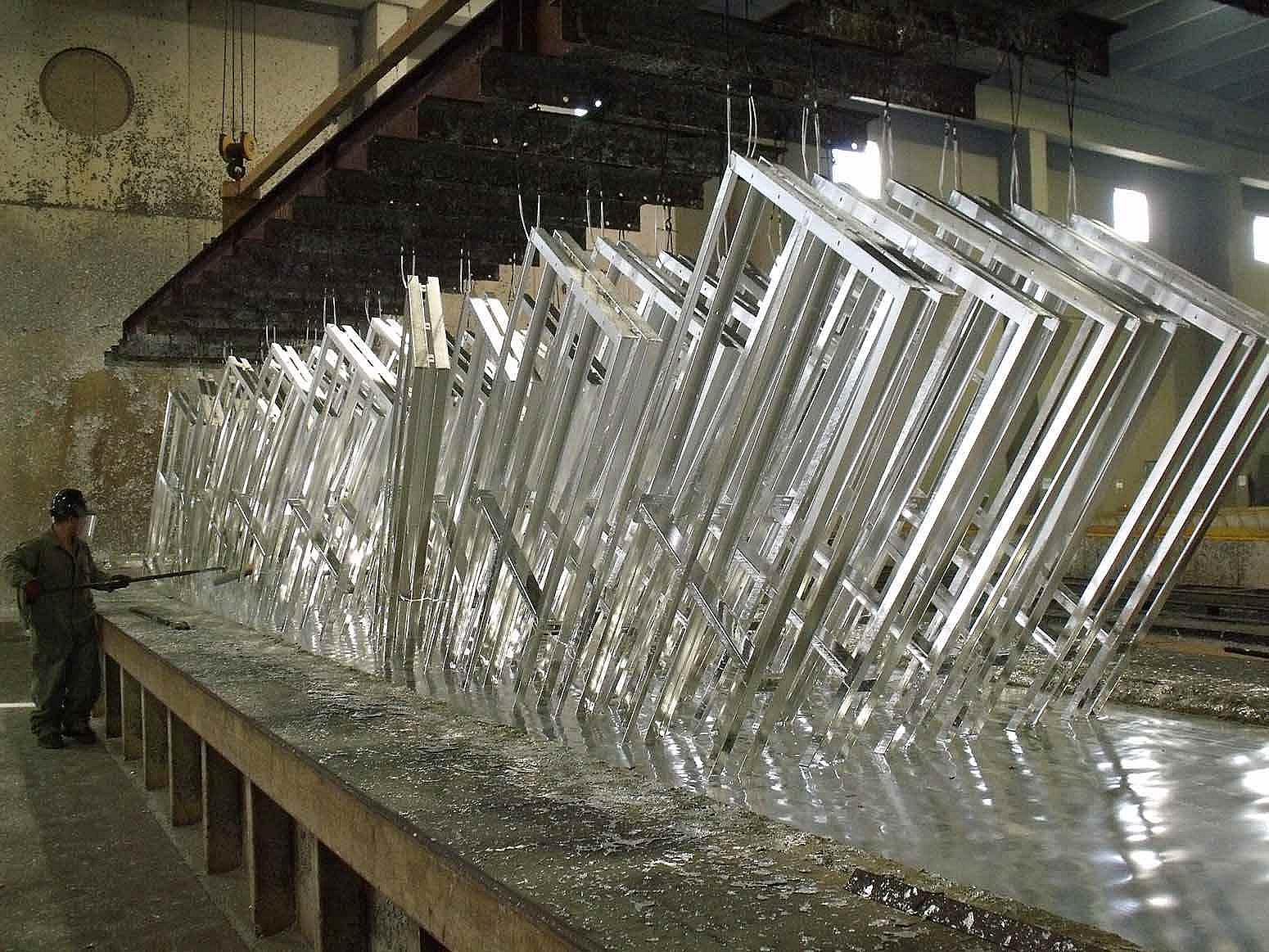
When steel enters the zinc bath, several metallurgical reactions begin immediately. As the steel warms up to bath temperature, the molten zinc begins to react with iron in the steel, forming a series of zinc-iron alloy layers. Once the reaction is complete, the article is withdrawn from the bath with a layer of pure zinc over the alloy layers. Unlike paints or powder coatings, these layers become part of the steel surface itself.
This metallurgical bond contributes to several performance characteristics:
- Strong adhesion (~3,600 PSI)
- Abrasion resistance
- Uniform coverage
- Long-term corrosion protection
Items too large for the kettle may still be galvanized if at least half can be dipped at a time. This is known as progressive dipping, one end is dipped, then the item is reoriented and the uncoated side is dipped, completing coating coverage. Progressive dipping does disrupt the regular flow of steel through the plant; always consult your galvanizer early on if your item is larger than their kettle. For more information, see following AGA resources to assist with progressive dipping:
- AGA Resources for Progressive Dip Calculations
- The Progressive Dip Process
- Progressive Dip Calculator
- Progressive Dip Charts
- Determining & Overcoming the Size Limitations of Hot-Dip Galvanizing
Step 9: Cooling and Finishing
After withdrawal from the zinc bath, steel enters the cooling stage.
Cooling may occur through:
- Ambient air cooling
- Water quenching
- Fans
As the coating cools, plant personnel may remove excess zinc accumulations when necessary and perform finishing operations consistent with applicable specifications. At this point, the coating has fully formed and the corrosion protection system is in place.
Step 10: Inspection and Quality Verification
Inspection represents one of the most important stages of the process. Rather than evaluating appearance alone, galvanizing specifications focus on measurable performance criteria.
Inspection typically includes:
- Visual examination
- Coating thickness verification
- Verification of coating continuity
- Touch-up/Repair
- Any additional work agreed upon by all parties and included in the purchase order (e.g. AESS categories)
Standards such as ASTM A123, ASTM A153, and ASTM A767 establish acceptance criteria for various galvanized products.
Step 11: Shipping and Delivery
Once inspection is complete, steel is prepared for shipment. The galvanized articles are staged, loaded, and transported to their final destination.
Unlike liquid-applied coating systems, galvanized steel can typically be loaded and transported immediately after inspection because the coating is fully "cured" as soon as it cools. In some cases, steel can be galvanized, shipped, and installed all on the same day.
Conclusion
Understanding the sequential process steel goes through at a galvanizing facility can help decision makers in many ways. Designers and fabricators can optimize parts for galvanizing to avoid delays, plan ahead regarding size and weight restrictions, and implement proper venting and drainage requirements. Project managers can take advantage of galvanizing’s factory-controlled process when planning transportation and installation. And inspectors that understand the difference between HDG and other coating systems can avoid common errors and misconceptions.