

The Corrosion Process of Galvanized Steel in Atmospheric Exposure

Hot-dip galvanized (HDG) steel is designed to protect steel from atmospheric corrosion for decades, but that protection is not static. From the moment freshly galvanized steel is exposed outdoors, the zinc coating begins interacting with the environment, gradually developing protective corrosion products while slowly sacrificing itself to preserve the underlying steel.
For engineers, owners, and specifiers, understanding this corrosion process is essential because service life, maintenance planning, and long-term risk are directly tied to how the galvanized coating changes over time. The progression follows a predictable sequence: formation of a protective zinc patina, gradual consumption of zinc, exposure of the zinc-iron alloy layers, and eventually the end of cathodic protection when the steel substrate becomes exposed.
What happens to freshly galvanized steel in the first days to months outdoors?
Freshly galvanized steel immediately begins reacting with the atmosphere. During the first days, weeks, and months of exposure, the zinc surface develops a series of stable corrosion products that ultimately form the protective zinc patina responsible for the coating's long-term durability.
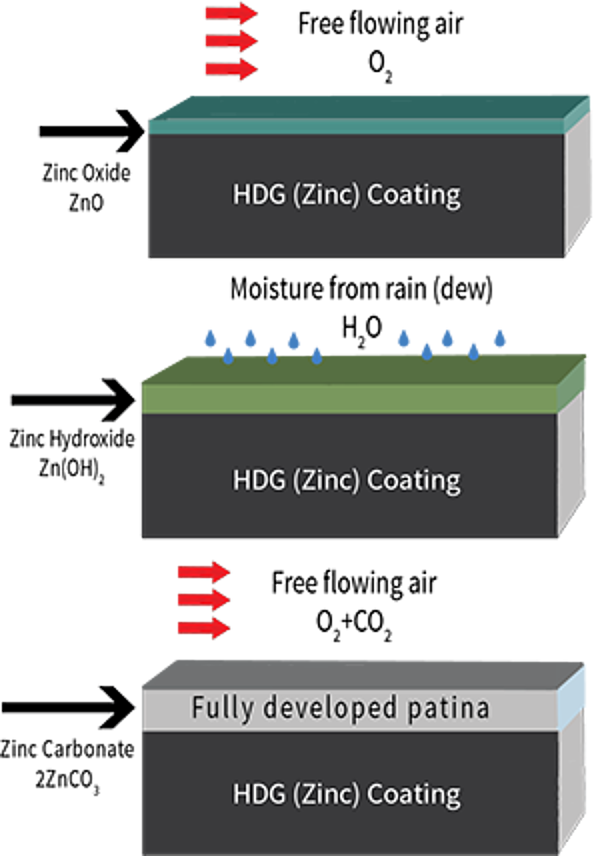
When galvanized steel first leaves the galvanizing kettle, the surface is composed primarily of zinc. Exposure to moisture, oxygen, and carbon dioxide initiates a series of natural chemical reactions. Zinc initially forms zinc oxide and zinc hydroxide compounds. Over time, these surface products react with atmospheric carbon dioxide to create stable zinc carbonate compounds that make up the patina.
Although the exact appearance and formation rate vary with steel chemistry and from site to site, several environmental factors influence early patina development:
- Frequency of wet/dry cycling
- Rainfall and natural rinsing
- Relative humidity
- Local air quality
- Exposure to chlorides or industrial pollutants
As the patina develops, the appearance of galvanized steel often changes from a bright, shiny finish to a more uniform matte gray.
How does the zinc patina control long-term atmospheric corrosion rates in HDG?
The zinc patina slows atmospheric corrosion by creating a stable barrier between the galvanized coating and the environment. Once fully developed, the patina reduces the rate at which zinc dissolves and significantly extends the service life of the galvanized coating.
Without this protective layer, zinc would corrode much more rapidly. Instead, the patina acts as a diffusion barrier that limits access of moisture, oxygen, and corrosive contaminants to the underlying zinc. As a result, corrosion rates generally decrease after the initial exposure period and remain relatively low for decades in most atmospheric environments.
Several environmental factors strongly influence long-term zinc corrosion rates:
- Time of Wetness (TOW): Longer periods of surface moisture generally increase corrosion activity.
- Chlorides: Salt deposits from marine environments or deicing salts can accelerate zinc consumption.
- Sulfur Dioxide (SO₂): Industrial pollutants can increase atmospheric corrosivity.
- Temperature: Higher temperatures may influence moisture retention and reaction rates.
- Humidity and Rainfall: These affect both corrosion activity and the beneficial rinsing of contaminants from the surface.
Typical Atmospheric Zinc Loss Rates
Environment |
Typical Zinc Loss Rate (µm/year) |
Rural |
~0.75 |
Urban/Suburban |
~1.00 |
Temperate Marine |
~1.15 |
Tropical Marine |
~1.26 |
Industrial |
~1.32 |
Table 1: Values represent average zinc corrosion rates used in development of the AGA Time to First Maintenance chart and will vary based on site-specific conditions.
An often-overlooked factor is whether galvanized steel is sheltered or unsheltered. Galvanized components exposed to normal rainfall benefit from periodic washing that removes contaminants and accumulated salts. By contrast, sheltered areas may remain dry but can accumulate corrosive deposits for long periods without natural rinsing.
This is particularly important in coastal environments, where sheltered surfaces can sometimes experience higher corrosion rates than nearby rain-washed surfaces because chlorides accumulate and remain concentrated.
In what sequence are HDG layers consumed until the steel substrate is exposed?
The galvanized coating is consumed in a predictable sequence. Atmospheric corrosion first acts on the patina, then the outer zinc layer, followed by the zinc-iron alloy layers, and finally the underlying steel substrate once the protective coating has been depleted.
Cathodic protection is the electrochemical protection provided when zinc preferentially corrodes instead of the underlying steel. This sacrificial behavior protects exposed steel at small discontinuities, scratches, and coating imperfections as long as adequate zinc remains nearby.
The progression generally follows these stages:
- Protective Patina
- The zinc carbonate patina forms and continually renews itself under normal atmospheric conditions.
- Eta (Pure Zinc) Layer
- The outer zinc layer gradually loses thickness through natural weathering and corrosion.
- Zinc-Iron Alloy Layers
- Once much of the outer zinc has been consumed, corrosion progresses into the zinc-iron intermetallic layers.
- Steel Substrate Exposure
- When all zinc-containing layers have been consumed, the underlying steel becomes exposed and red rust can develop.
The zinc-iron alloy layers behave somewhat differently than pure zinc because they contain a mixture of zinc and iron formed during galvanizing. These intermetallic layers are generally harder and more dense than the outer zinc layer and often corrode at different rates depending on environmental conditions and coating structure.
Available zinc thickness ÷ long-term zinc corrosion rate
In other words, thicker galvanized coatings exposed to lower-corrosivity environments provide longer periods before maintenance or repair becomes necessary. This predictable relationship is one of the major advantages of hot-dip galvanizing for infrastructure and long-life assets.
The primary service-life variable for galvanized steel is straightforward: environmental corrosivity plus coating thickness determines the maintenance horizon.
Because atmospheric zinc corrosion rates are relatively predictable, engineers can estimate long-term performance using established tools such as the Time to First Maintenance (TFM) Chart and the Zinc Coating Life Predictor (ZCLP).
For the most reliable life-cycle predictions, specify the appropriate galvanized coating thickness, verify the actual exposure category, and evaluate site-specific conditions that may increase corrosion severity. With these factors understood, the atmospheric corrosion process of galvanized steel becomes highly predictable, allowing owners to make informed maintenance and durability decisions decades in advance.
References
- https://galvanizeit.org/hot-dip-galvanizing/how-long-does-hdg-last/in-the-atmosphere/time-to-first-maintenance/atmospheric-corrosion-data
- https://zclp.galvanizeit.org/methodology
- https://zclp.galvanizeit.org/glossary
- https://galvanizeit.org/knowledgebase/article/hdg-corrosion-rates-for-iso-categories-c1-c5-x