
How Duplex Systems Extend Service Life

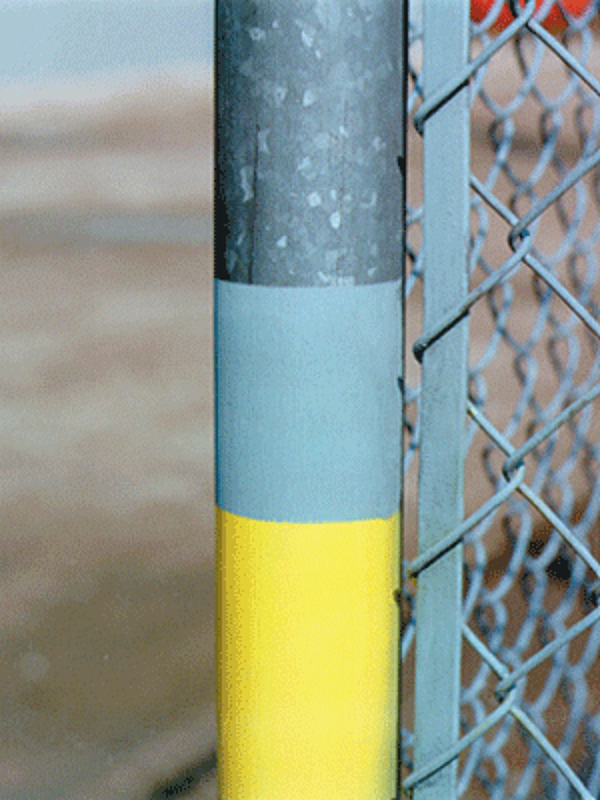
Galvanizing plus paint or powder coating extends service life because the topcoat slows zinc consumption while the zinc coating protects exposed steel at coating discontinuities, scratches, and damage points. This combination delays corrosion mechanisms that can affect single-coat systems and extends the interval before significant maintenance becomes necessary.
Hot-dip galvanized steel protects through both barrier and sacrificial protection. Paint and powder coatings primarily provide barrier protection by stopping moisture, oxygen, and contaminants from reaching the substrate. When combined into a duplex system, each layer protects the other.
The topcoat shields the zinc coating from environmental exposure, slowing zinc corrosion. At the same time, the zinc layer remains available to provide both underfilm protection and cathodic protection if the topcoat is damaged during service.
Why Duplex Systems Last Longer
- The topcoat reduces exposure of the zinc coating to moisture and contaminants.
- The zinc coating protects exposed steel at coating holidays, scratches, and damage points.
- Zinc corrosion products help limit underfilm corrosion.
- Maintenance can be performed before steel corrosion develops.
AGA guidance notes that duplex systems commonly achieve a service-life multiplier of approximately 1.5 to 2.3 times the combined life of the galvanizing and topcoat systems individually. This relationship is commonly referred to as a synergistic effect and provides a useful planning tool when evaluating long-term maintenance strategies.
Maintenance-Free Life Examples
Paint Life (Years) |
HDG Life (Years) |
Duplex Multiplier |
Estimated Maintenance-Free Life (Years) |
10 |
50 |
1.5 |
90 |
10 |
50 |
2.3 |
138 |
15 |
35 |
1.7 |
85 |
20 |
40 |
2.0 |
120 |
These examples are intended for planning purposes and should be evaluated against actual exposure conditions, coating specifications, and expected maintenance practices.
For many owners, the value is not found in the multiplier itself but in what it represents. Longer maintenance intervals can reduce scaffold costs, shutdown requirements, traffic control measures, and labor expenditures. On industrial facilities, elevated structures, and transportation infrastructure, reducing maintenance frequency can significantly affect lifecycle cost and operational disruptions.
Estimating Time-to-First-Maintenance for Duplex Systems
Time-to-first-maintenance can be estimated by first determining the expected life of the paint or powder coating, then estimating HDG life based on zinc thickness and environmental conditions, and finally applying an environment-based duplex multiplier to the combined total.
A structured approach helps ensure assumptions remain transparent and repeatable:
- Establish environmental severity. Consider salinity, pollution levels, humidity, rainfall, and wet-dry cycling characteristics that may influence corrosion rates.
- Estimate HDG service life. Begin with the specified zinc coating thickness and evaluate expected corrosion rates for the environment.
- Estimate topcoat life. Use coating manufacturer data, project specifications, or documented field performance. AGA guidance identifies approximately 10 to 20 years as a practical planning range for many paint and powder coating systems when properly applied.
- Select an appropriate duplex multiplier.
- 1.5 for severe marine or highly polluted environments
- 1.5-1.6 for seawater and immersion service
- 1.7-2.0 for industrial and marine atmospheres
- 2.0-2.3 for rural, suburban, and lower-corrosivity environments
- Calculate Time to First Maintenance (TFM)
Time to First Maintenance = (Duplex Multiplier) × (HDG Life + Topcoat Life)
The resulting value provides a useful baseline for lifecycle cost comparisons and maintenance planning.
It is important to note that this calculation assumes no maintenance occurs during the estimated period. In actual service, coatings are often maintained before significant deterioration develops, essentially restarting the process.
When a duplex system is maintained before substantial zinc loss occurs, recoating can restore the barrier layer while preserving the galvanized coating underneath. This characteristic makes duplex systems particularly attractive for existing galvanized structures where regalvanizing may not be practical due to size, access limitations, or operational constraints.
Steps to Promote a Successful Duplex System
The most effective way to reduce technical risk in a duplex system is through proper surface preparation and clearly defined responsibilities throughout the supply chain. To assist, the AGA has produced guidance on Preparing HDG for Paint and Preparing HDG for Powder Coating. Reviewing these resources during specification development can help establish realistic preparation requirements before fabrication schedules and handling plans are finalized. Successful projects are sure to include a clear specification and division of surface preparation responsibilities.
Practical Implications for Long-Term Asset Performance
Duplex systems are fundamentally a service-life strategy. By combining the barrier protection of paint or powder coatings with the sacrificial protection of galvanizing, they create a corrosion protection system that often outperforms either system acting alone.
For structures exposed to marine environments, industrial atmospheres, deicing salts, or difficult maintenance conditions, duplex systems can provide meaningful improvements in durability, maintenance reduction, and lifecycle performance. AGA guidance has consistently demonstrated that the duplex effect can significantly extend maintenance cycles life when the system is properly specified and applied.
Ultimately, success depends less on the choice of coatings and more on disciplined execution. When project teams align surface preparation requirements, coating compatibility, inspection procedures, and maintenance expectations early in the design process, duplex systems become a practical tool for extending service life and improving long-term asset management outcomes.