
How Zinc Coating Thickness is Related to Service Life

When protecting steel from corrosion, one of the most important factors influencing long-term performance is zinc coating thickness. Because zinc corrodes at a predictable rate in a given environment, coating thickness serves as a reliable indicator of expected service life. As the zinc coating gradually weathers, it continues to protect the steel beneath through both barrier protection and galvanic action. Simply put, a zinc coating's service life is directly proportional to coating thickness.
Understanding the relationship between coating thickness and corrosion rates helps specifiers, engineers, architects, and owners select the appropriate level of corrosion protection while balancing long-term durability and project costs.
The Relationship Between Zinc Thickness and Service Life
The service life of a zinc coating is primarily determined by two factors: the initial coating thickness and the rate at which zinc is consumed in its specific environment.
As zinc reacts with oxygen, moisture, and atmospheric contaminants, it develops a stable patina consisting of zinc corrosion products. This patina slows the corrosion process and contributes to zinc's exceptional long-term performance in a wide range of environments. As long as zinc remains on the steel surface, the underlying steel is protected from corrosion.
Because atmospheric zinc corrosion occurs at relatively predictable rates, service life can be estimated using a simple relationship:
Estimated Service Life ≈ Zinc Coating Thickness ÷ Average Zinc Corrosion Rate
While this relationship provides a useful framework, actual performance depends heavily on environmental conditions. Zinc corrosion rates vary significantly based on moisture exposure, airborne salts, industrial pollutants, and local microclimates.
For example, a zinc coating measuring 6 mils exposed to an environment where zinc corrodes at an average rate of 0.040 mils per year (C3 suburban) would be expected to provide approximately 150 years of service before complete zinc consumption.

Although simplified calculations help illustrate the relationship between thickness and longevity, real-world service life should always be evaluated in the context of the actual exposure environment. The AGA Zinc Coating Life Predictor allows users to estimate expected coating life based on geographic location and environmental conditions using long-term corrosion data. The AGA also publishes a Time-to-First Maintenance chart to quickly estimate the service life of HDG coatings to when 5% of the steel surface exhibits rust.
Environmental Factors That Influence Zinc Corrosion Rates
The environment surrounding a steel structure plays a significant role in determining how quickly a zinc coating is consumed over time. Even within the same facility, corrosion rates can vary substantially depending on exposure conditions and structural detailing.
Time of Wetness
Time of Wetness (TOW) refers to the amount of time moisture remains on a surface. Zinc corrosion occurs primarily when a conductive moisture film is present, making drying cycles an important factor in service life. Structures that remain wet for extended periods due to rain, condensation, poor drainage, or sheltered conditions generally experience higher corrosion rates than surfaces that dry quickly.
Chloride Exposure
Chlorides from marine environments and deicing salts can accelerate corrosion by increasing the conductivity of moisture films on the surface of the zinc coating. Structures located near shorelines, saltwater splash zones, or transportation corridors treated with deicing salts often experience higher zinc consumption rates than identical structures located farther inland.
Industrial Pollutants
Atmospheric contaminants, including sulfur-containing compounds and certain industrial emissions, can increase zinc corrosion rates in industrial environments. Although air quality improvements have reduced sulfur dioxide levels in many regions, industrial facilities may still present unique exposure conditions requiring consideration during the design process.
Structural Detailing and Water Retention
Design details can create localized conditions that influence coating performance. Areas that trap moisture, debris, or standing water often experience greater corrosion than freely draining surfaces. Proper drainage, adequate venting, and thoughtful detailing help maximize coating performance and ensure more uniform long-term corrosion protection.
Understanding Environmental Corrosivity
Atmospheric environments are commonly categorized using ISO corrosivity classifications ranging from C1 (very low corrosivity) to C5 (very high corrosivity).
Examples include:
- C1: Dry interior environments
- C2: Rural and low-pollution environments
- C3: Urban and light industrial environments
- C4: Industrial and coastal environments
- C5: Highly corrosive industrial or marine environments
As environmental aggressiveness increases, zinc corrosion rates increase correspondingly, reducing expected service life for a given coating thickness. Understanding the anticipated exposure category provides a starting point for understanding the expected service life.
Example: Zinc Coating Thickness and Estimated Service Life
| Zinc Coating Thickness | Typical Example | Zinc Corrosion Rate | Estimated Service Life* |
|---|---|---|---|
| 2 mils | Thin zinc coating | 0.040 mils/year (C3 Suburban) | ~50 years |
| 4 mils | Heavy zinc coating | 0.040 mils/year (C3 Suburban) | ~100 years |
| 6 mils | Typical hot-dip galvanized structural steel | 0.040 mils/year (C3 Suburban) | ~150 years |
| 8 mils | Heavy hot-dip galvanized coating | 0.040 mils/year (C3 Suburban) | ~200 years |
| 10 mils | Very thick galvanized coating | 0.040 mils/year (C3 Suburban) | ~250 years |
*Estimated service life calculated using: Service Life ≈ Zinc Coating Thickness ÷ Average Zinc Corrosion Rate. Actual performance will vary based on environmental conditions, design detailing, and local exposure factors.
The Benefits of Hot-Dip Galvanized Coating Thickness
Not all galvanized products have the same coating thickness, density, or expected service life. Continuously galvanized sheet products, electrogalvanized coatings, and hot-dip galvanized fabricated steel all provide different thickness ranges and performance characteristics.
For fabricated steel, hot-dip galvanizing provides one of the thickest and most durable zinc coatings available. Unlike many other zinc coating methods, hot-dip galvanizing forms a metallurgically bonded coating consisting of zinc-iron alloy layers and an outer layer of pure zinc. The resulting coating is highly resistant to damage during transportation, erection, and service.
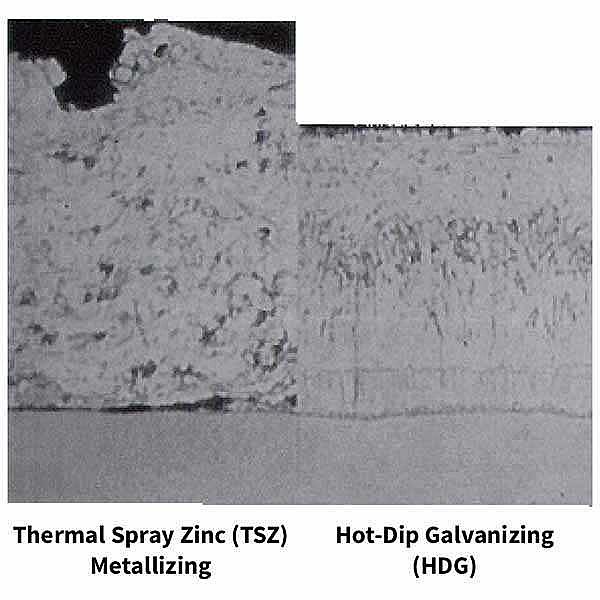
Hot-dip galvanized coatings have a denser zinc concentration than other zinc coatings. For example, because of porosity, a metallized or thermal spray zinc (TSZ) coating has approximately 15% less zinc than a hot-dip galvanized coating of the same thickness. This directly translates to a longer maintenance-free service life for HDG coatings compared to equivalent thickness TSZ coatings.
Another advantage of hot-dip galvanizing is complete coverage. Interior and exterior surfaces, edges, corners, and difficult-to-reach areas receive protection during the galvanizing process. The coating grows perpendicular to all surfaces as the diffusion reaction between iron and zinc takes place in the kettle. This uniform protection helps eliminate many of the discontinuities common with other coating systems.
Note: Coating thickness requirements for hot-dip galvanized steel are established by ASTM A123, with actual coating thicknesses frequently exceeding the minimum specification requirements.
Conclusion
Zinc coating thickness is one of the most reliable predictors of long-term corrosion performance. Because zinc corrodes at measurable and predictable rates in atmospheric environments, thicker coatings generally provide longer service life and extended maintenance-free protection. By understanding environmental corrosivity and evaluating anticipated service-life requirements, designers can make informed specification decisions that maximize durability and long-term value. The AGA has published additional information on the various types zinc coatings and their characteristics that provides a helpful table comparison.