

Rust Stains on Galvanized Steel: Transfer or Coating Damage?

One of the most common questions surrounding hot-dip galvanized steel occurs when reddish-brown discoloration appears on a galvanized surface. The immediate assumption is often that the galvanized coating has failed and the underlying steel is rusting. However, that is not always the case.
In many instances, what appears to be rust on galvanized steel is merely surface staining caused by contamination, rust transfer, environmental deposits, or oxidation within the galvanized coating itself rather than active corrosion of the base steel. Distinguishing between cosmetic staining and true coating damage is important because the appropriate response can range from doing nothing at all to performing a repair in accordance with ASTM A780. Fortunately, a combination of visual assessment and a few simple field checks can usually provide the answer.
What Do Rust Stains on Galvanized Steel Usually Indicate in the Field?
In most cases, rust-colored staining on galvanized steel does not indicate coating failure. The discoloration may originate from external sources such as nearby carbon steel, grinding dust, or iron-bearing debris deposited on the galvanized surface. In other cases, the staining may result from oxidation of iron contained within the galvanized coating's zinc-iron alloy layers, even though zinc protection remains present and the underlying steel is not corroding.
Rust staining is discoloration that occurs on the surface of a galvanized coating while the zinc coating remains intact and continues protecting the steel.
Red rust is corrosion of the underlying steel substrate that occurs where the galvanized coating has been damaged, consumed, or was never present.
This distinction is important because galvanized steel can exhibit reddish or brown staining even while adequate zinc coating remains beneath the affected area. In such cases, the appearance may be undesirable, but the long-term corrosion protection of the galvanized coating is generally unaffected.
The confusion often stems from a simple question: "If the surface is red or brown, isn't the galvanized steel rusting?" Sometimes yes, but often no. A closer inspection usually reveals whether the staining originated from the galvanized steel itself, from an external source, or from oxidation of iron within the galvanized coating's intermetallic layers.
Field Tip: The presence of rust-colored staining alone is not evidence of galvanized coating failure. Brown staining can occur even when zinc coating remains present and continues to protect the steel. Always verify whether adequate galvanized coating remains beneath the affected area before recommending repairs.
How Can You Visually Troubleshoot Rust Stains on Galvanized Steel?
A careful visual inspection is often enough to identify the most likely source of the discoloration. While laboratory testing is occasionally warranted for critical applications, most field evaluations can be completed with simple observations and a basic understanding of common staining mechanisms.
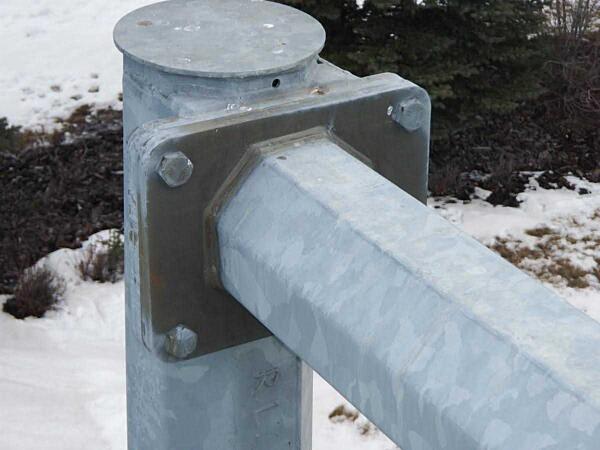
Light Brown Film or Patchy Discoloration
A thin brown film or patchy brown discoloration is often staining rather than evidence of steel corrosion. In some cases, the discoloration originates from environmental deposits, airborne contaminants, or weathering products that accumulate on the galvanized surface.
However, brown staining can also develop because of the galvanized coating itself. Brown staining may occur when iron within the zinc-iron alloy layers of the galvanized coating becomes exposed and oxidizes. This condition typically develops after portions of the outer pure zinc layer have weathered away in localized areas, allowing oxidation of iron contained within the intermetallic layers of the coating. Although the appearance may resemble rust, zinc coating remains present and the underlying steel is protected.
The galvanized coating typically remains intact beneath the discoloration, and the affected area rarely exhibits the metal loss, roughness, or localized attack associated with true red rust on exposed steel.
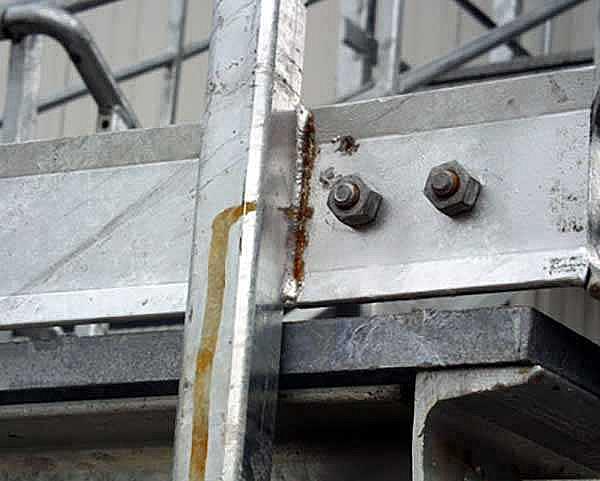
Orange Streaks Below Connections, Fasteners, or Edges
Orange streaks extending downward from joints, fasteners, or steel-to-steel connections often indicate rust transfer rather than corrosion of the galvanized member itself.
Examples include carbon steel particles deposited during fabrication, corrosion products washing off adjacent steel components, or contamination introduced during construction activities. Gravity and water runoff frequently create vertical streaking patterns that can be mistaken for coating failure.
Localized Red Rust at an Impact Area or Deep Scratch
Localized red rust concentrated within a small damaged area is often a sign of a true coating breach. Mechanical damage caused by impact, welding, grinding, cutting, or aggressive handling can expose bare steel.
Unlike surface staining, these areas typically show corrosion confined to the damaged location and may be accompanied by visible coating disruption. When bare steel is exposed, repairs should be evaluated using the criteria outlined in ASTM A780.
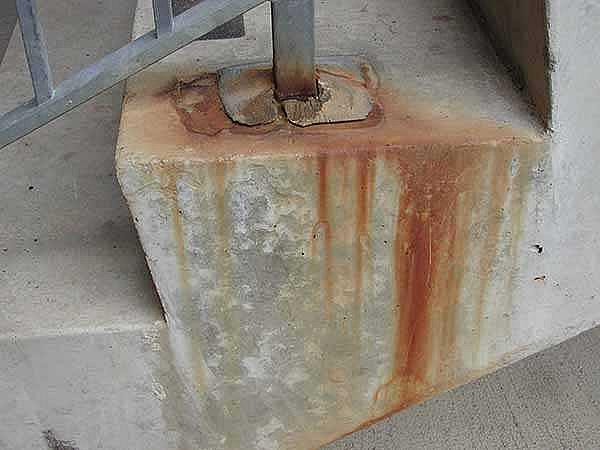
Staining Around Crevices and Water Collection Areas
Crevices, tight overlaps, and areas where moisture remains trapped may develop staining over time. These locations should be inspected carefully to determine whether the staining represents harmless deposits, brown staining, wet storage stain residue, or actual coating deterioration.
The key is to determine whether zinc remains present beneath the stained area and whether corrosion is progressing.
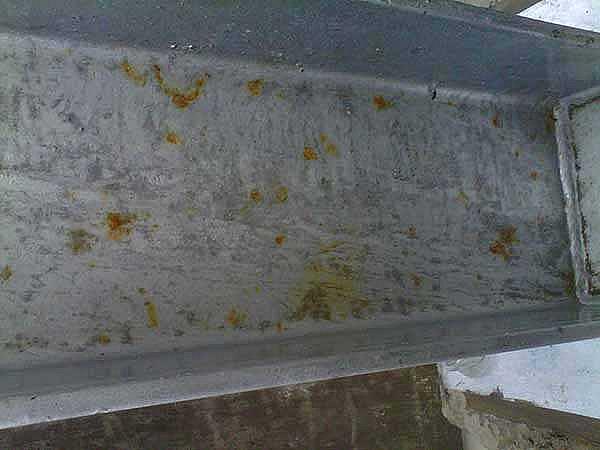
Rust-Colored Spots Near Grinding or Fabrication Activities
Grinding swarf and steel fabrication debris are common causes of staining on galvanized steel. Tiny iron particles become embedded in the zinc surface and subsequently rust, creating isolated reddish-brown spots.
Although unsightly, these spots usually originate from contamination rather than corrosion of the galvanized steel itself.
What Quick Tests Can Confirm Rust Transfer Versus True Coating Damage?
Several simple field tests can quickly help determine whether a stain is cosmetic or indicative of steel corrosion.
1. Wipe or Brush Test
Lightly clean the stained area with a cloth, nylon brush, or other non-aggressive cleaning method.
If the discoloration is largely removed and a sound galvanized surface remains beneath, the stain likely originated from contamination or rust transfer rather than coating failure.
2. Magnetic Thickness Gauge Check
Measure coating thickness directly in the stained area. If the expected zinc coating thickness remains present, the galvanized coating is still protecting the steel. In fact, this is one of the easiest ways to distinguish brown staining from true red rust. Brown staining can occur while zinc remains present beneath the affected area, whereas red rust on steel typically indicates the galvanized coating has been consumed or is absent at that location.
3. Context Check
Evaluate the surrounding environment and construction history. Look for nearby carbon steel, grinding operations, cutting activities, dissimilar metal contact, or runoff from uncoated steel components. These factors frequently explain staining that initially appears to be galvanized coating failure.
In rare situations involving critical structures, disputed claims, or high-consequence applications, laboratory analysis or metallographic examination may be appropriate. For most projects, however, visual inspection and basic field testing provide sufficient information to reach a practical conclusion.
Table 1: Troubleshooting Rust
Observation |
Likely Cause |
Verify With |
Action |
Light brown discoloration with zinc coating present |
Brown staining, oxidation of intermetallic layers, or surface contamination |
Wipe test, coating thickness measurement |
No action or clean only |
Orange streaks beneath connections or adjacent steel |
Rust transfer from nearby carbon steel |
Visual inspection and context review |
No action or clean only |
Red rust concentrated at a scratch, gouge, or damaged area |
Coating breach exposing steel |
Visual inspection and thickness gauge |
Repair per ASTM A780 |
Persistent corrosion-like staining with uncertain cause |
Coating damage, contamination, or unusual exposure condition |
Thickness measurement and further evaluation |
Further inspection |
Distinguishing rust staining from actual coating damage prevents unnecessary repairs while ensuring legitimate coating deficiencies are addressed appropriately. Before assuming a galvanized coating has failed, take the time to determine whether the discoloration is merely cosmetic, the result of rust transfer, or evidence of exposed steel. In many cases, what appears to be corrosion is simply staining on an otherwise intact and highly effective galvanized coating.