
Preventing Wet Storage Stain During Shipping and Storage

Few conditions generate more questions after a delivery than finding wet storage stain (WSS) on freshly galvanized steel. The white or gray powdery deposits appear between contact surfaces, beneath strapping, or in areas where moisture collected during transit. Oftentimes customers or erectors express concerns about the quality of the coating or the integrity of the galvanizing process.
In reality, wet storage stain has nothing to do with the galvanizing process. It is a storage and handling issue. The condition develops due to natural reactions involving newly galvanized steel. In most cases, exposure to natural wet and dry cycles in the installation environment will naturally resolve the issue. However, when moisture is trapped in contact with HDG steel during storage, the stain can remain.
WSS is primarily cosmetic, and not a structural problem. However, if moisture remains trapped long enough, zinc consumption can become significant enough to warrant evaluation and corrective action. But the vast majority of cases do not meaningfully reduce the expected service life of the galvanized coating.
What Is Wet Storage Stain?
Wet storage stain usually appears as a white or gray zinc corrosion product that forms when moisture remains trapped on newly galvanized steel in areas with limited airflow. It is commonly found on stacked, bundled, nested, or tightly packed galvanized products.
Once exposed to the atmosphere, zinc begins forming a protective surface layer known as the zinc patina. The process starts with zinc oxide and zinc hydroxide formation, which gradually convert into a stable zinc carbonate layer through exposure to carbon dioxide in the air. This patina develops naturally over time and is responsible for much of galvanized steel's long-term corrosion resistance. Full patina development typically takes about six to twelve months depending on environmental conditions.
Wet storage stain occurs when that normal weathering process is interrupted. When moisture is trapped between galvanized surfaces and airflow is restricted, oxygen and carbon dioxide cannot reach the surface in sufficient quantities. Instead of converting to stable zinc carbonate, zinc corrosion products continue building on the surface as zinc hydroxide and zinc oxide.
One important point for inspectors and owners: appearance can be deceiving. Wet storage stain corrosion products can occupy roughly three to five times the volume of the zinc consumed to create them. A surface that appears heavily stained may still retain a substantial amount of galvanized coating.
Why Does Wet Storage Stain Develop During Shipping?
Shipping and storage frequently create the exact conditions wet storage stain needs to develop: moisture, restricted airflow, and time.
Condensation is often the primary culprit. A bundle may leave the galvanizer dry, travel through changing temperatures, and develop condensation once the steel temperature falls below the dew point. If the bundle is tightly wrapped or nested, that moisture cannot evaporate quickly.
Several common shipping practices increase the likelihood of moisture entrapment:
- Tight nesting of galvanized components
- Face-to-face stacking without spacers
- Non-breathable shrink wrap or plastic coverings used long term, rather than as a temporary splash shield
- Flat storage orientations that prevent drainage
- Long-term storage of wet bundles before inspection
- Fully enclosed packaging that traps condensation
Winter transportation introduces an additional challenge. During transport, galvanized steel may be exposed to road spray containing sodium chloride, magnesium chloride, calcium chloride, and other deicing chemicals. Chlorides increase the conductivity of moisture on the zinc surface and can accelerate wet storage stain formation, particularly where salty water becomes trapped in contact areas.
This is why projects sometimes encounter more frequent staining during winter or spring deliveries than during other times of the year.
How to Prevent Wet Storage Stain
The most effective prevention strategy is simple: Keep galvanized steel dry whenever possible, allow water to drain when it gets wet, and maintain airflow around the coating. Proper storage and ventilation are often the most effective defenses against wet storage stain. AGA publishes guidance in the publication Wet Storage Stain.
Promote Drainage
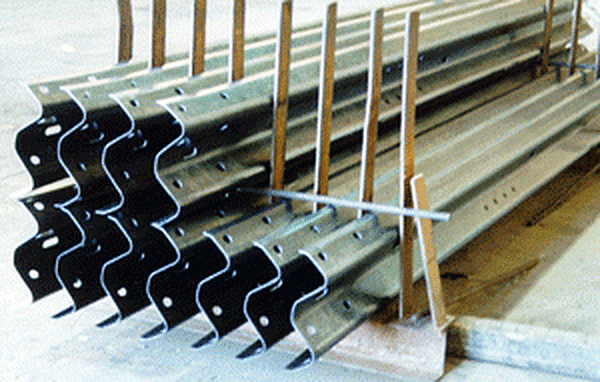
Bundles should be stored at an incline whenever practical so water can drain naturally from surfaces, laps, channels, and contact points. Even covered materials should be positioned so moisture does not collect after rain, condensation, or wash-down activities.
Maintain Airflow
Galvanized components should be separated using spacers whenever condensation or prolonged storage is expected. Air circulation allows trapped moisture to evaporate before significant corrosion products can develop.
Particular attention should be given to:
- Nested structural shapes
- Plate and sheet bundles
- Handrail systems
- Pipe bundles
- Grating assemblies
These products naturally create moisture-trapping contact points if stacked tightly.
Use Proper Dunnage and Spacers
According to AGA guidance, spacer wood should be dry, untreated, and non-resinous. Resinous species can contribute to corrosion problems and should be avoided. Poplar and spruce have historically been used successfully for spacer applications.
Galvanized steel should also be elevated above soil, vegetation, and standing water to improve drainage and airflow.
Cover Smart, Not Tight
Shippers often use shrink wrap or tightly sealed coverings to protect galvanized steel from rain. Unfortunately, these same coverings can lock moisture against the surface once condensation develops. Tight coverings are effective primarily as a temporary shield, but not for long term storage.
An ideal cover would keep precipitation off the steel while still allowing moisture to escape. Ventilated covers often perform better than fully sealed wrapping when long-term storage is anticipated.
Conclusion
Wet storage stain prevention is ultimately a logistics issue, not a problem with the coating. The galvanized coating is performing exactly as zinc is expected to perform when moisture becomes trapped and airflow is restricted.
The most successful projects intentionally store HDG steel in a way that promotes drainage, maintains airflow, and removes contaminants before storage. Those three practices eliminate the conditions that create wet storage stain and help ensure newly galvanized steel develops the protective zinc patina necessary for decades of corrosion protection.