
Post-Weld Repair for Galvanized Steel: Choosing HDG Repair Materials

Introduction
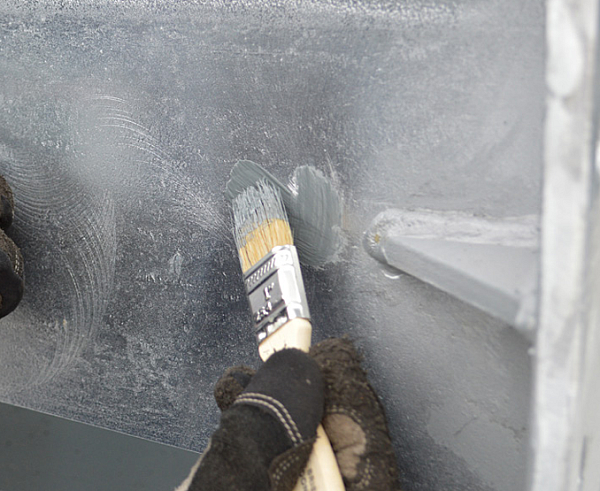
Welding in the field or during erection are common realities on steel projects, even when the original intent is to complete all fabrication before hot-dip galvanizing. Fit-up adjustments, project modifications, and site-specific conditions can require welding after hot-dip galvanizing, where the zinc coating must typically be removed from the weld area to ensure weld quality. The resulting bare steel must then be repaired. The objective is straightforward: restore the coating and therefore corrosion protection.
ASTM A780, Practice for Repair of Damaged and Uncoated Areas of Hot-Dip Galvanized Coatings, establishes the accepted framework and materials used for repairing welded and damaged galvanized areas. The standard identifies acceptable materials and surface preparations, but leaves project-specific selections or products to specifiers. Depending on project requirements, specifiers may allow all permitted choices and let the installation/erection team decide specific materials, specify methods and materials in advance, or take an approach between these extremes. This article reviews common considerations to guide those selections.
Repair Material Selection
Restoring corrosion protection means re-establishing both barrier protection and sacrificial (cathodic) protection so the repaired area can perform similarly to the surrounding galvanized coating. For this reason, ASTM A780 recognizes three acceptable repair methods: zinc-rich paint, thermal spray zinc (metallizing), and zinc-based solder. Each HDG repair material presents specific pros and cons, but it is possible to achieve a successful and durable coating repair using each method if the material meets the requirements specified by ASTM A780/A780M and is applied according to the manufacturers’ recommendations.
For a list of commonly available repair materials in the marketplace today, AGA publishes a listing of various manufacturers and products for the maintenance and repair of hot-dip galvanized structures is available for download.
Zinc-rich paint is recognized as the most common repair material used for field repair after welding. Spray-application of zinc-rich paint (aerosol can) is recommended only for cosmetic touch up. While it is theoretically possible to use this method for repairing bare areas in the coating, it is challenging to satisfy the requirements in ASTM A780/A780M. For this reason, brush applied formulations are recommended for field repair of bare areas. Additional considerations such as compatibility between zinc-rich paint and subsequent coatings should be considered when field painting.
Repair size and accessibility also influence selection. Welding often requires mechanical grinding a few inches beyond the weld itself. Zinc-based solders and thermal spray zinc cannot be used on certain surfaces or surface orientations in the field because of limitations related to their application methods. On projects where zinc-based solder or thermal spray zinc are specified as the preferred repair method, it is still necessary to specify a zinc-rich paint for addressing edges, overhead surfaces, and inaccessible areas.
ASTM A780/A780M specifies repair materials based on their corrosion resistance rather than appearance. Although it is not possible to guarantee HDG repair materials will precisely match the color of the HDG coating, material selection may consider aesthetics when necessary.
Regarding performance, all three ASTM A780 repair methods can provide durable corrosion protection when properly specified, correctly applied, and inspected. A comparison of performance characteristics pertinent for some projects is provided below.
Comparison of ASTM A780 Repair Materials
Factor |
Zinc-Rich Paint |
Metallizing (Zinc Thermal Spray) |
Zinc-Based Solder |
Corrosion Protection |
Very good |
Excellent |
Very good |
Adhesion |
Dependent on surface preparation and application. Strong mechanical bond. |
Dependent on surface preparation. Strong mechanical bond. |
Dependent on surface preparation |
Abrasion Resistance |
Generally lowest |
Generally highest |
Moderate |
Equipment Required |
Brush, roller, or spray equipment |
Thermal spray equipment |
Heating equipment |
Applicator Sensitivity |
Lowest |
Highest |
Low |
Field Accessibility |
Excellent |
Lowest |
Moderate |
Relative Cost |
Lowest |
Highest |
Low to Moderate |
Appearance Match |
Various color options available, but may weather different from the galvanizing |
Most similar to base galvanizing |
Blends well with surrounding coating |
Typical Field Applications |
All repairs |
Larger repairs and demanding environments |
Localized repairs on flat surfaces |
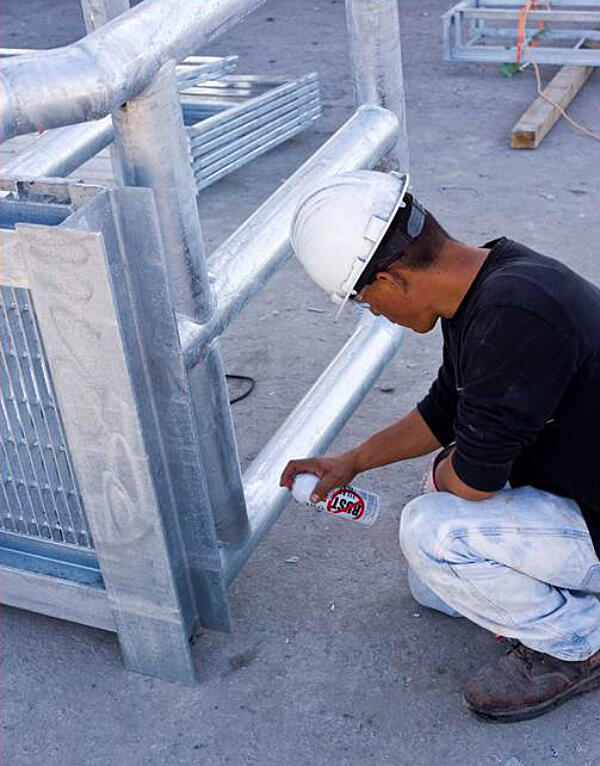
Zinc-Rich Paint After Welding Galvanized Steel
Zinc-rich paint is the most commonly used repair material for field touch-up work.
Advantages
- Well suited for typical field weld repairs
- Requires relatively simple equipment
- Can be applied by brush, roller, or spray
- Readily available from multiple manufacturers
- Practical in elevated, confined, or otherwise difficult-to-access locations
- Generally carries the lowest mobilization cost
Considerations
- Performance depends heavily on surface preparation
- Lower abrasion resistance than metallizing
- Film thickness control is critical
- Excessive coating thickness can lead to mud cracking[BJ1]
- Appearance may differ from adjacent galvanized areas
For many projects, particularly localized weld repairs, zinc-rich paint offers the most practical combination of performance, cost, and field applicability.
Metallizing Repair After Welding Galvanized Steel
Metallizing repairs are created by spraying molten zinc onto a prepared surface.
Advantages
- Excellent corrosion protection
- High abrasion resistance
- Closely replicates the behavior of galvanized zinc coatings
- Often provides a more uniform visual appearance
- Well suited for larger repair areas
- Frequently selected when long-term durability is the primary objective
Considerations
- Requires specialized thermal spray equipment
- Greater operator skill requirements
- More demanding surface preparation
- Higher installation and mobilization costs
- Access limitations can complicate field application
Metallizing is often attractive when significant surface area has been affected by welding or when the repaired area is expected to experience handling wear, maintenance traffic, or abrasion during service.
Zinc-Based Solder Repair After Welding Galvanized Steel
Zinc-based solder creates a metallic zinc repair through controlled heating and alloy application.
Advantages
- Creates a metallic zinc repair layer
- Excellent visual blending with surrounding galvanizing
- Forms a metallurgical bond
- Effective for small, localized repairs
- Can provide a high-quality finish on visually exposed components
Considerations
- Requires preheating during application
- Application becomes more challenging as repair size increases
- Geometry can limit practicality
- Requires careful workmanship for consistent results
- Less efficient than other methods for extensive repair areas
Zinc-based solder can be a practical choice when a metallic zinc repair is desired and the geometry allows proper application.