
Zebra Striping/Fish Bone Effect


What causes the appearance of fish boning on pipes or tubes? Is there anything that can be done to mitigate or reduce the chances of fish boning?
When hot-dip galvanizing tubular fabrications, sometimes a phenomenon known as fish boning can occur. Fish boning, sometimes called zebra striping, runs, or tearing, is caused by differences in the surface steel chemistry, usually with large diameter steel pieces. The variations in the reaction rate between iron within the steel and molten zinc cause an irregular pattern to appear, resembling fish bones or zebra stripes (figure 1). Although this surface condition does not affect the long-term corrosion performance of the coating and is acceptable, the aesthetics can be considered sub-optimal.
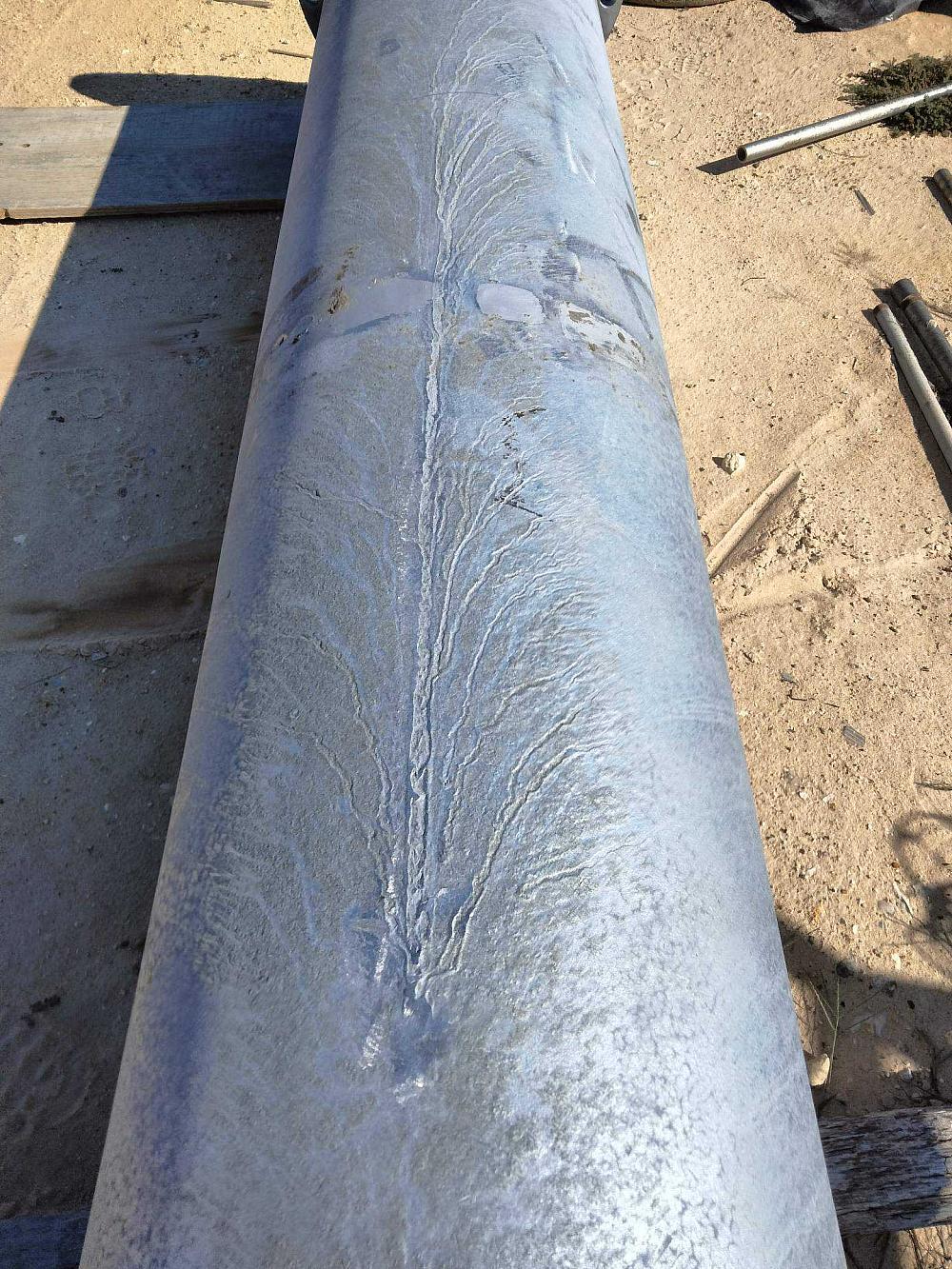
Fish boning is primarily a problem with tubular fabrications, or sometimes hollow structural sections (HSS), where excess zinc is able to run down the sides after withdrawal from the kettle. AGA member galvanizers have found some process parameters can increase the likelihood of fish boning to appear. Stripping and re-galvanizing, pre-blasting with aggressive media, and non-uniform surface chemistry, seem to be the most common contributors.
Several small adjustments, when combined, can meaningfully increase the chances of avoiding fish boning. Here’s a list of practical steps you can take to reduce the likelihood of fish boning.
- Avoid stripping and re-galvanizing when possible. If re-galvanizing is necessary, run stripped material back through a caustic/neutralizing bath and then through a second full strength (non-stripping tank) chemical cleaning (acid) bath.
- If you are blasting before galvanizing, avoid aggressive blast media. Surface roughness in general is known to be conducive to fish boning.
- Extract parts in a vertical position when possible to limit irregular longitudinal flow of zinc around parts.
- If practical, minimize dip times on articles prone to fish boning.
One galvanizer found identical HSS tubes would show fish boning on parts positioned in cooler areas of the zinc bath, but not on parts positioned in slightly warmer areas of the bath from the same batch. They also found success avoiding fish boning by using air knives to remove excess zinc on long or curved parts immediately after galvanizing.
The existing knowledge on the fish boning effect is limited, and the AGA technical department is constantly adding new information to our library. The TSC (Technical Services Committee) Coating Performance Subcommittee is currently exploring further research into fish boning. If you have photos or information regarding fish boning please contact us at [email protected]
© 2026 American Galvanizers Association. The material provided herein has been developed to provide accurate and authoritative information about after-fabrication hot-dip galvanized steel. This material provides general information only and is not intended as a substitute for competent professional examination and verification as to suitability and applicability. The information provided herein is not intended as a representation or warranty on the part of the AGA. Anyone making use of this information assumes all liability arising from such use.