
Internal Venting of Hot-Dip Galvanized Hollow and Tubular Steel Fabrications

Venting and drainage holes are a common, necessary design detail when hot-dip galvanizing hollow and tubular products. They allow trapped air, pretreatment solutions, molten zinc, and hot-dip galvanizing skimmings to safely evacuate the fabrication during processing. The American Galvanizers Association (AGA) strongly recommends external, visible, and verifiable venting and drainage holes for hot-dip galvanized hollow and tubular steel fabrications. AGA does not recommend relying on internal venting alone because verification can be difficult or impossible. This creates avoidable risks for projects, including material damage, processing delays, additional review, rejected work, rework, unexpected field corrections, schedule impacts, and increased project costs, as well as safety concerns for galvanizing personnel and equipment.
Proper venting and drainage holes should be viewed as a design and fabrication detail that supports a more predictable galvanizing outcome. When venting and drainage holes are visible and accessible, the galvanizer can confirm that the fabrication is ready for cleaning, fluxing, and galvanizing before processing begins. This helps reduce uncertainty, avoids last-minute questions, and improves the likelihood the steel can move through the galvanizing process efficiently. For designers and fabricators, this means fewer surprises, fewer production delays, and a clearer path to achieving both coating quality and project schedule expectations.
In contrast, projects that rely on internal venting alone leave much of the risk concealed within the fabrication. Even when internal venting is shown on drawings or communicated to the fabricator, the galvanizer may not be able to confirm whether every internal opening was provided, is properly located, or remains unobstructed. If a hollow fabrication contains trapped air, moisture, or cleaning solutions, pressure can build rapidly during immersion in the galvanizing kettle, creating the potential for material damage. While worker safety remains the most important reason to avoid unverifiable internal venting, the same condition can also damage the fabrication, require repairs or replacement, delay delivery, and create additional cost for the project team.
AGA recognizes that engineers, designers, fabricators, architects, and owners may prefer internal venting for practical reasons. Common concerns include appearance, visible holes, water entry, project-specific design requirements, or owner preference. These concerns are valid and should be addressed early in the design and detailing process. However, internal venting is not the only way to address these concerns, and in most cases, it is not the simplest or most reliable option.
There are several easy, effective, and generally low-cost alternatives that allow the fabrication to remain safe and visibly vented during galvanizing while still meeting project expectations after galvanizing. When exposed holes are a concern, tapered hole plugs made from aluminum or zinc, custom plugs shapes, or other closure options can be used after galvanizing to improve the appearance (Figure 1).
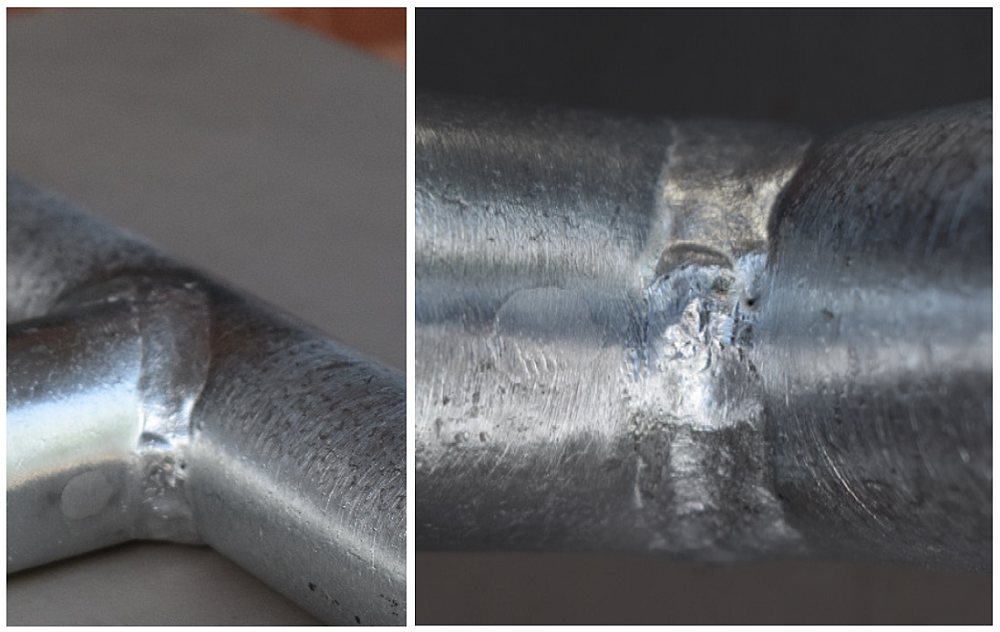
Where water intrusion is a concern, watertight sealing strategies and compatible sealants can provide a practical solution for some projects when properly specified and maintained. For example, a silicone, polyurethane, or acrylic caulk/sealant may be applied around the hole according to the manufacturer’s instructions before installing the tapered plug and sanding it flush. These approaches are typically easier to coordinate early than to resolve problems after fabrication or galvanizing.
© 2026 American Galvanizers Association. The material provided herein has been developed to provide accurate and authoritative information about after-fabrication hot-dip galvanized steel. This material provides general information only and is not intended as a substitute for competent professional examination and verification as to suitability and applicability. The information provided herein is not intended as a representation or warranty on the part of the AGA. Anyone making use of this information assumes all liability arising from such use.